


Have a Tree Fall on Your Home in Connecticut? What to Do First

A tree on a roof looks like a cleanup job, but it is better understood as a structural event. The tree is carrying load, the house is carrying load, and some of that weight is now being shared in ways neither was designed for. The decisions you make in the first hour affect how safely the tree comes off and how smoothly the insurance claim goes.
At Green Valley Tree, we respond to these calls across Eastern and Central Connecticut after nor’easters, ice storms, and the occasional summer microburst. The situations differ, but the right order of operations is almost always the same. This guide walks through it, including a few things homeowners rarely hear until they are already in the middle of it.
Tree down right now? Contact Green Valley Tree and we will get you on the schedule.
Make the Scene Safe Before Anything Else
Start with people and pets. Move everyone out of any room the tree is touching or hanging over, and keep them out until the structure has been looked at. A roof that appears to be holding may have cracked rafters or a displaced ridge that will not announce itself until more weight shifts.
Call 911 if anyone is hurt, if you smell gas, or if you see smoke or sparks. If the tree has hit the side of the house near a gas meter, leave the area and let the utility respond.
Treat Every Wire as Live
Trees and power lines tend to come down together, and a tree resting on a line can energize everything it touches, including the ground around it and wet fencing. Stay at least 30 feet back and keep children and pets away. Report downed lines to 911 and to your electric utility, which in most of Connecticut is Eversource or United Illuminating.
One detail catches many homeowners off guard. Even when the line in the street is fine, a falling tree can rip the service mast and weatherhead off the side of the house, which is the pipe and connection that bring power into your meter. If that has happened, the utility will need to disconnect power, and a licensed electrician will need to repair the mast before power can be restored. A tree crew cannot work near that connection until it has been made safe, so it is worth reporting early.
Document the Tree Before Anyone Moves It
Photos and video are the most useful thing you can create in the first hour, because once removal begins the original condition is gone. Take them from a safe distance and include:
- The full tree, from more than one angle, showing where it came from and where it landed
- The break point or the base, including whether the root system lifted out of the ground
- Every area of damage to the roof, siding, windows, gutters, fencing, and vehicles
- Any interior leaks or ceiling damage
Do not climb onto a damaged roof or stand under a loaded limb for a better shot. A photo from the lawn is enough. Your insurer will want to see how the tree sat on the structure, and the crew doing the removal will use the same images to plan their approach.
Call Your Insurance Company Early
Report the loss as soon as you can and ask what your policy covers. Many policies treat a tree that damaged a covered structure differently from one that fell in the yard without hitting anything, and the details vary by policy, so ask directly which situation yours falls under. Also ask whether they need an adjuster to see the tree in place before it is moved.
If the situation is unsafe, do not hold up emergency work waiting for an adjuster. Document thoroughly, make the area safe, and keep every invoice, including any temporary repairs.
Why You Should Not Cut It Yourself
Storm-cleanup injuries are common, and most of them happen to homeowners who start cutting a tree that looked straightforward. The problem is that a tree lying across a structure is rarely just resting. It is usually bearing against the roof at one point, held up by a limb on another, and bent under tension somewhere along its length.
Wood that has been bent under load stores energy the way a spring does. When a cut releases it, the trunk or limb can snap sideways, roll, or drop onto the roof with much more force than the tree was applying a moment before. Arborists call this a spring pole, and it is one of the most dangerous situations in tree work.
There is a second hazard when the tree has uprooted. The root plate, the disk of soil and roots tipped up at the base, can weigh several tons. When the weight of the trunk is removed, that plate can settle back toward the hole it came from, sometimes suddenly. Crews account for this before a single cut is made.

How a Professional Crew Removes a Tree From a House
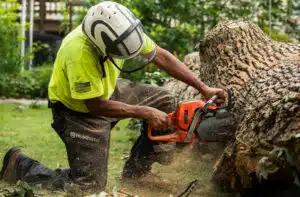
A removal like this is planned before it starts. A crew leader will look at how the tree is loaded, where it is bearing on the structure, and which cuts will release tension and which will increase it. The sequence matters as much as the cuts themselves.
Work generally starts at the top and moves down, with sections of the tree rigged and lowered by rope rather than dropped. When the tree is large or the access is tight, a crane changes the job entirely. The crane takes the weight of each section before it is cut free, so the piece lifts away from the roof instead of falling onto it. Our crane and mechanical removal services exist for exactly these situations, and they are often the difference between a clean removal and additional damage to a house that has already taken a hit.
Winter adds its own conditions. Ice and snow on the roof make footing worse and add weight, which can slow the work. Frozen ground, on the other hand, can help heavy equipment reach a backyard without tearing up the lawn.
Once the tree is off the structure, the remaining wood is cleared or chipped, and stump grinding can be scheduled if the stump or root plate needs to be dealt with. Our emergency tree service handles the full sequence, from the first assessment through cleanup.
Protect the House After the Tree Is Off
Once the tree is gone, the roof opening becomes the priority. Water intrusion does more damage in a few days than most people expect, because wet insulation and drywall can lead to mold if they stay damp. Tarping the opening is reasonable, and your insurer will generally expect you to take sensible steps to prevent further loss. Tarp from the ground or have a roofer do it. A temporary leak is a far better problem than a fall from a damaged roof.
Before anyone repairs the structure, have a roofer or contractor check the framing underneath. A roof can look fixable from the outside while a cracked rafter or ridge board is quietly carrying load it should not be.
Be Careful Who You Hire After a Storm
After a major storm, crews arrive in town from out of the area, often going door to door and quoting quick, cash-only work. Some are perfectly capable, but many are not insured, and a removal from a roof is the worst possible job to hand to an uninsured crew.
Before work begins, ask for proof of liability insurance and workers’ compensation coverage, and ask how they plan to take the tree off the structure. A reputable company will describe the plan clearly, will not pressure you to pay in full up front, and will put the scope of work in writing.
Look at the Trees That Are Still Standing
When one tree fails, the trees around it deserve a closer look. Trees that grew in a group often relied on each other for wind protection, and removing one exposes its neighbors to loads they were never used to. After the emergency is handled, walk the property and look for:
- Soil that is cracked or lifting around the base of a nearby tree
- A lean that is new or has increased since last season
- Large dead limbs in the canopy, especially over the house or driveway
- Trees on the edge of a cleared area that now catch more wind
It is also worth asking why the first tree failed. A trunk that snapped above ground often points to internal decay or a weak structure, while a tree that came out at the roots usually points to saturated soil or root problems. That tells you what to watch for in the remaining trees. Our guides on storm-proofing your trees and when a tree should be removed cover the warning signs in detail. Selective pruning, cabling and bracing, or removal of a compromised tree now can prevent a repeat of the same call next storm.
Serving Homeowners Across Eastern and Central Connecticut
Green Valley Tree works with residential homeowners throughout Chaplin, Mansfield, Windham, Killingly, Andover, Bolton, Coventry, Colchester, Haddam, East Hampton, Bozrah, Glastonbury, Avon, Simsbury, Manchester, Waterford, Norwich, and surrounding towns. Whether the tree is on the roof, through a fence, or across the driveway, we can assess it, remove it safely, and help you get back to normal.
Contact Green Valley Tree today and we will get a crew headed your way.
Frequently Asked Questions
Who should I call first when a tree falls on my house?
Call 911 if anyone is hurt or if there is fire, gas, or a downed line. Once everyone is safe, call your insurance company and a licensed, insured tree service with emergency capability.
Is it safe to stay in the house with a tree on the roof?
Not necessarily. The tree can shift, and the framing underneath may be damaged in ways you cannot see. If you are unsure, stay out of the affected area until a professional has looked at it.
Should I wait for the adjuster before the tree is removed?
If there is an active hazard, make the situation safe first and document everything with photos and video. If the situation is stable, ask your insurer what they require before work begins.
What should I have ready when I call a tree service?
Your address, where the tree is sitting, whether any power lines are involved, and whether anyone is injured. Photos help, as does a note about access, such as gates, narrow driveways, or soft ground.
What if my neighbor’s tree fell on my house?
Responsibility depends on the circumstances, including the condition of the tree beforehand and the terms of each policy. Take thorough photos and talk to your insurance provider, and to an attorney if the situation is disputed.
Can the stump be removed after the tree is gone?
Yes. Once the tree is cleared and the area is safe, stump grinding can be scheduled as a follow-up. Our tree removal services cover everything from a single tree to multiple trees after a major storm.