
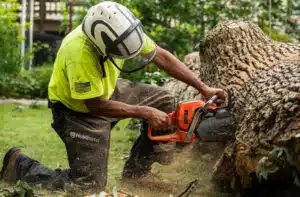


How to Tell If Your Tree Is a Storm Risk Before the Next Big One Hits

Every Connecticut homeowner knows the feeling. The sky turns that strange green-gray color, the wind picks up fast, and suddenly you are looking out the window at the big tree near your house wondering, for the first time in years, whether it is actually going to hold.
By then, it is too late to do much about it.
July and August are when Connecticut sees its most intense summer storms. Fast-moving thunderstorms, microbursts, and the occasional tropical system can bring sustained winds and sudden gusts that put real stress on trees, especially ones that have been quietly developing problems for years without anyone noticing.
The good news is that most storm-risk trees give warning signs well before a storm ever arrives. You just have to know what to look for. This guide walks you through a practical, no-equipment-needed self-check you can do this weekend, so you know which trees on your property are solid and which ones deserve a closer look before the next big one hits.
Want a professional opinion before storm season ramps up? Contact Green Valley Tree and we will take a look.
Why Summer Storms Are Different From Winter Storms
Connecticut trees deal with stress all year, but summer storms create a different kind of pressure than winter weather does.
In winter, ice and snow load weigh branches down slowly, and the damage tends to be gradual. In summer, the threat is sudden lateral force. A fast-moving thunderstorm can bring wind gusts of 50, 60, or even 70 miles per hour with almost no warning. That kind of sudden side-to-side force is exactly what exposes weaknesses in a tree's structure, root system, or canopy balance.
A tree that handled last winter's snow load just fine can still be at serious risk in a summer storm if it has a structural issue that only matters under wind pressure. That is why a fresh look at your trees heading into peak storm season is worth doing, even if everything seemed fine a few months ago.
The Four-Point Storm Risk Self-Check
You do not need to be an arborist to spot the major red flags. Walk around each large tree on your property, particularly ones near your house, driveway, or anywhere people spend time, and look at these four things.
1. Lean
Some trees have always had a slight lean and have been stable that way for decades. That is usually not a concern on its own. What matters is new or worsening lean.
Things to look for:
- A tree that appears to be leaning more than it did last year
- Soil that looks disturbed, cracked, or lifted on one side of the trunk's base
- A gap or mound forming in the soil where roots meet the ground
If a tree's lean has changed recently, especially after a wet spring, that often points to root movement. A tree with compromised roots can fail even in moderate wind, because the part of the system that should be holding it in place is no longer doing its job. This is one of the clearer signs that a tree may need to come down before it becomes a bigger problem
2. Canopy Weight and Balance
A tree's canopy, meaning its overall mass of branches and leaves, acts like a sail in high wind. The bigger and more lopsided that sail is, the more force the trunk and roots have to resist.
Things to look for:
- A canopy that is heavily weighted to one side, often because of past pruning, nearby structures, or competition from other trees
- Large, heavy limbs extending far out horizontally, especially over a roof, driveway, or patio
- Dense, overgrown canopies that have not been thinned in several years
A canopy that is dense and one-sided catches more wind on that side and creates more leverage on the trunk and root system. This is one of the most common, and most fixable, storm risk factors. Pruning and crown thinning can reduce this risk significantly without removing the tree.
3. Root Flare and Base Condition
The root flare is the area where the trunk widens out and transitions into the root system at ground level. This area tells you a lot about a tree's stability.
Things to look for:
- A root flare that is buried under soil, mulch, or grass, so the trunk looks like a straight pole going into the ground rather than flaring out
- Mushrooms, fungal growth, or soft, spongy wood at the base
- Cavities, large wounds, or sections of missing bark near the base
- Visible roots that have been cut, damaged, or compacted by nearby construction, driveways, or lawn equipment
A healthy root flare is a strong indicator of a stable base. A buried flare, decayed base, or damaged root system is one of the most serious storm risk factors there is, because it directly affects whether the tree can resist being pushed over.
4. Proximity to Structures
This last point is not about the tree's health at all. It is about consequence.
A tree with a minor issue that is 100 feet from your house in a wooded area is a very different situation than a tree with the same issue standing 15 feet from your roofline. Proximity does not make a tree more likely to fail, but it dramatically changes what happens if it does.
When you are doing your walkthrough, pay special attention to:
- Trees directly over or near the roofline
- Trees within falling distance of where vehicles are parked
- Trees near power lines running to your house
- Large limbs extending over decks, patios, or play areas
Any tree that shows even one or two of the warning signs above, and is also close to a structure, moves to the top of the list for a professional look.

What These Warning Signs Actually Mean
Finding one of these signs does not automatically mean a tree needs to come down. It means the tree needs a closer, professional look to determine what is actually going on and what the right response is.
In many cases, the right response is far less drastic than removal. Here is how these situations often play out:
A tree with a heavy, one-sided canopy but a healthy trunk and root system is often a good candidate for crown thinning and selective pruning. Reducing canopy weight and improving balance lowers wind resistance without removing the tree.
A tree with a structural weakness, such as a split trunk, a weak branch union, or a multi-stem tree with stems pulling apart, may be a strong candidate for cabling and bracing. This involves installing support systems that help hold the tree together and reduce the chance of failure during high wind, while preserving a tree that is otherwise healthy and valuable to the property. Our cabling and bracing services are designed for exactly this kind of situation.
A tree with significant root damage, a buried or decayed root flare, or a trunk with extensive internal decay is a different story. These issues affect the tree's fundamental ability to stay upright, and pruning or bracing cannot fix a failing foundation. In these cases, removal is usually the safer and more honest recommendation, even when it is not what anyone wants to hear.
The point of the self-check is not to diagnose your trees yourself. It is to know which trees are worth having a professional take a look at before storm season, rather than finding out the hard way during one.
A Quick Reference: What to Look For
|
Warning Sign |
What It May Mean |
Possible Next Step |
|
New or worsening lean |
Root movement or failure |
Professional evaluation, possible removal |
|
Heavy, one-sided canopy |
Increased wind resistance, leverage on trunk |
Crown thinning, pruning |
|
Split trunk or weak branch union |
Structural weakness |
Cabling and bracing |
|
Buried or decayed root flare |
Compromised base stability |
Professional evaluation, possible removal |
|
Mushrooms or soft wood at base |
Internal decay |
Professional evaluation, possible removal |
|
Large limbs over roof or driveway |
High consequence if failure occurs |
Pruning, possible removal depending on cause |
Why Now Is the Right Time to Check
Connecticut's heaviest storm activity typically runs from mid-summer through early fall. Once a severe thunderstorm warning is in effect, there is very little that can be done about a tree that has a structural problem. Pruning, cabling, and removal all require dry conditions, proper equipment access, and time to schedule and complete safely.
That is exactly why early-to-mid summer is the ideal window. Trees are fully leafed out, which actually makes some issues, like canopy imbalance, easier to see. There is still time to schedule pruning, bracing, or removal before the most active part of storm season arrives. And if a tree does need to come down, planned removal during good weather is significantly safer and less expensive than emergency removal after a storm.
When It Is More Than a Self-Check Situation
If your walkthrough turns up a tree that is already showing active signs of failure, such as a trunk that has visibly cracked recently, a tree that has shifted noticeably in the last few weeks, or large dead limbs hanging in the canopy over a structure, do not wait for a scheduled appointment.
Our emergency tree service is available for situations where a tree presents an immediate hazard, whether that is before, during, or after a storm.
Serving Homeowners Across Eastern and Central Connecticut
Green Valley Tree works with residential homeowners throughout Eastern and Central Connecticut, including Chaplin, Mansfield, Windham, Killingly, Andover, Bolton, Coventry, Colchester, Haddam, East Hampton, Bozrah, Glastonbury, Avon, Simsbury, Manchester, Waterford, and Norwich.
If your self-check turned up a tree you are not sure about, or if you would simply like a professional opinion before storm season picks up, we are happy to come take a look.
Contact Green Valley Tree today to get your trees checked before the next big storm.
Frequently Asked Questions
How often should I check my trees for storm risk?
A walkthrough once or twice a year, ideally in spring and again in early summer before peak storm season, is a good baseline. Trees that have shown warning signs in the past or that are close to structures may benefit from more frequent attention.
Can a leaning tree be saved, or does it always need to come down?
It depends on the cause. A tree that has always had a slight lean and is otherwise healthy is often fine. A tree with a new or worsening lean, especially one connected to root movement, is more likely to need removal, since root systems cannot typically be repaired once significantly compromised.
Is cabling and bracing a permanent fix?
Cabling and bracing systems can last many years with proper installation and occasional inspection, but they are a support measure rather than a permanent structural repair. They are most effective on trees with a specific weak point, such as a split trunk or weak branch union, where the rest of the tree is healthy.
What if I cannot tell if what I am seeing is a problem?
If anything during your self-check gives you pause, even something minor, it is worth having a second opinion rather than guessing. Reach out to our team and we can take a look and let you know exactly what we recommend.
Does homeowners insurance cover tree damage from storms?
Coverage varies by policy and by the specifics of the situation, including whether the tree was healthy before the storm. This is a question best directed to your insurance provider, but maintaining your trees and addressing known risks ahead of time can support a claim if something does happen.
What is the best time of year to address a storm-risk tree in CT?
Late spring through early summer is ideal. Trees are fully leafed out, which makes canopy issues easier to spot, and there is still time to schedule pruning, bracing, or removal before peak storm season arrives in midsummer.