
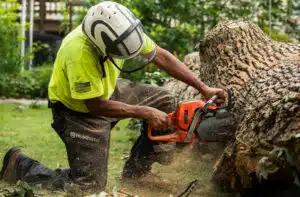


Fall Tree Removal in Connecticut: 5 Reasons to Do It Before Winter

Most Connecticut homeowners assume tree work is a spring thing. The weather warms up, the yard comes back to life, and suddenly the list of outdoor projects appears. Tree removal tends to land somewhere on that list, scheduled for whenever things calm down.
Here is the thing though. Fall is actually one of the best times of year to have a tree removed in Connecticut, and in several ways it is better than spring. If you have a tree on your property that needs to come down, waiting until April or May is not doing you any favors.
This guide covers exactly why fall tree removal makes sense for CT homeowners, what to look for when deciding whether a tree should come down before winter, and how to make the most of the remaining fall window before the ground freezes.
Have a tree that needs to come down this fall? Contact Green Valley Tree and we will take a look.
Why Fall Is a Smart Window for Tree Removal in CT
The Leaves Are Gone or Going
Once a tree drops its leaves, everything about it becomes easier to see and easier to work with. Crews can see the full branch structure clearly, which means better decisions about how to take the tree down safely. Sight lines to the ground are open. The canopy is not catching material the way it does in full leaf.
For homeowners, a leafless tree also makes it much easier to spot the problems that should have been addressed months ago. Cracks in the trunk, dead limbs, weak branch unions, significant leans that were hidden behind a full canopy all become visible once fall strips the tree back. If you walk your property after leaf drop and notice something that concerns you on a tree near your house, that is worth acting on before winter arrives.
The Ground Is Still Firm
This is one of the most practical advantages of fall removal that most homeowners never think about. Tree removal involves heavy equipment. Chippers, loaders, stump grinders, and in some cases cranes all need to access your property without tearing up the lawn or getting stuck.
In early spring, the ground in Connecticut is saturated from snowmelt and rain. Equipment leaves ruts, turf gets damaged, and access to certain areas of a property becomes complicated. In fall, the ground is typically firm and dry from a summer of drainage. Equipment moves cleanly, access is straightforward, and your lawn comes out of the job looking the way it went in.
Stump Grinding Works Better Before Ground Freeze
If you want the stump gone along with the tree, fall is your window. Stump grinding works best in firm, workable soil. Once the ground freezes in December and January, grinding becomes harder, slower, and in some cases has to wait until spring thaw entirely.
Removing the tree and grinding the stump in the same fall visit gets the whole job done cleanly while conditions are ideal. Come spring, the ground where the stump was has the full winter to settle, and you can seed or plant over it in April with no delay. Our stump grinding service handles this as part of the removal process for homeowners throughout Eastern and Central CT.
Scheduling Is More Flexible
Spring is the busiest season for tree work in Connecticut. Homeowners who spent all winter looking at a problem tree call in March and April, crews book up fast, and wait times stretch out. Fall tends to be more open. If you want your preferred crew, your preferred timing, and a job that gets done on your schedule rather than whoever is next on the list, fall is when that is most achievable.
You Get Ahead of Winter Storm Risk
This is probably the most important reason of all. Connecticut winters bring ice storms, heavy snow loads, nor’easters, and the kind of sustained wind events that put real pressure on trees. A tree that is already dead, declining, or structurally compromised heading into winter is a liability. Ice accumulation alone can add hundreds of pounds of weight to a canopy that is already struggling to hold itself together.
Removing a hazardous tree in October or November eliminates that risk entirely before the first major storm of the season. The alternative, waiting until spring, means gambling on whether that tree makes it through four or five months of Connecticut winter without failing onto a roof, a vehicle, a fence, or a power line.
Planned removal in fall is also significantly less expensive and more controlled than emergency removal in January after a tree has already partially failed. Our emergency tree service is available when that situation arises, but avoiding it entirely is always the better outcome.

What Types of Trees Should Come Down Before Winter
Not every tree is urgent, but certain situations make fall removal the clearly right call. Here is what to prioritize before the cold sets in.
Dead or fully declining trees
A dead tree is not going to get better over winter. It is going to get more brittle, more unpredictable, and more dangerous. Dead wood becomes increasingly fragile under ice and snow load, and a tree that seemed stable in September can fail without warning in February. If a tree on your property is dead or dying, fall removal is not something to put off.
Trees with significant structural problems
Cracks in the trunk, large deadwood in the canopy, a noticeable lean that developed over the past year, or a multi-stem tree where the stems are visibly pulling apart. Any of these represent structural problems that winter weather will stress further. Trees in this condition near homes, driveways, or any structure should be evaluated and addressed before the first ice storm.
Trees too close to the house, garage, or power lines
Proximity matters more in winter than any other season. A tree that overhangs your roofline, sits within falling distance of your garage, or is growing into the power lines feeding your house becomes a higher risk every time a major storm rolls through. If removal has been on your mind for one of these trees, fall is the time to stop thinking about it and make the call.
Trees affected by insects or disease
Trees weakened by emerald ash borer, fungal disease, or other stress factors are more susceptible to failure under winter load. If you have ash trees on your property that have not been evaluated in recent years, fall is a good time to have them looked at. Ash that has been significantly impacted by EAB may need to come down before their structural integrity deteriorates further.

What About Trees That Do Not Need Full Removal
Not every tree that has an issue needs to come down. Fall is also a good time to address problems that have a solution short of removal.
Pruning and deadwood removal
Getting dead limbs, crowded branches, and hazardous wood out of the canopy before winter reduces the amount of material that can fail under ice and snow load. Tree trimming and pruning done in fall sets your trees up to handle winter better and reduces cleanup after major storms.
Cabling and bracing
For trees with a specific structural weakness, such as a multi-stem situation or a large limb with a weak attachment point, cabling can provide support through the winter months when snow and ice loading is at its highest. This is often a practical option for trees that are otherwise healthy and worth preserving.
Large or complex removals
Some trees require more than a standard crew and chainsaw. Large trees in tight spaces, trees leaning over structures, or removals that require working around power lines may need crane assistance. Our crane and mechanical removal services handle exactly those situations, and fall scheduling means we can plan the job properly rather than rushing it.
How Long Is the Fall Window?
In Connecticut, the practical fall window for tree removal typically runs from mid-October through late November or early December, depending on the year. Ground conditions, weather patterns, and the specifics of any given property affect this, but as a general rule the window closes when the ground freezes hard enough to limit equipment access and stump grinding becomes impractical.
If you have a tree you have been thinking about, now is the time to get it looked at and scheduled rather than waiting to see how the next few weeks play out. Once the ground freezes, the options narrow.
Green Valley Tree serves homeowners throughout Eastern and Central Connecticut including Chaplin, Mansfield, Windham, Killingly, Andover, Bolton, Coventry, Colchester, Haddam, East Hampton, Bozrah, Glastonbury, Avon, Simsbury, Manchester, Waterford, and Norwich. We are familiar with the conditions and tree species across the region and can give you a straight answer on what needs to happen before winter.
Contact Green Valley Tree today to schedule your fall tree removal before the window closes.
Quick Reference: Fall vs Spring Tree Removal in CT
|
Factor |
Fall |
Spring |
|
Ground conditions |
Firm and dry, ideal for equipment |
Often saturated from snowmelt |
|
Scheduling availability |
More flexible, less backlog |
Busiest season, longer wait times |
|
Canopy visibility |
Leafless, full structure visible |
Full leaf, harder to assess |
|
Stump grinding |
Optimal before ground freeze |
Possible but delayed by wet ground |
|
Storm risk heading in |
Eliminated before winter |
Tree exposed to full winter first |
|
Lawn impact |
Minimal with firm ground |
Higher risk of ruts and turf damage |
Frequently Asked Questions
Is fall really a good time to remove a tree, or is spring better?
For most situations, fall is equal to or better than spring for tree removal in Connecticut. Firm ground, open scheduling, leafless canopies, and the ability to eliminate winter storm risk all work in favor of fall removal. Spring has a longer season ahead of it, but it also brings saturated soil, full crews, and longer wait times.
Will tree removal damage my lawn in fall?
Fall is actually one of the better times for lawn preservation during tree work. The ground is firm from summer drainage, which means equipment moves cleanly without leaving ruts. Spring removals on saturated ground are more likely to cause turf damage.
Can you remove a tree in winter in Connecticut?
Yes, winter removal is possible and sometimes preferable for certain situations, particularly when the ground is frozen hard enough to support equipment without damaging the lawn. However, stump grinding becomes more difficult in frozen ground, and scheduling flexibility narrows in the coldest months. Fall remains the more practical window for most homeowners.
How do I know if a tree needs to come down before winter?
The key signs are a tree that is dead or significantly declining, one that has visible structural problems like cracks or a new lean, a tree that sits close to your home or a structure, or one that has been weakened by disease or insects. If any of those apply and you are within the fall window, it is worth getting a professional opinion now rather than in spring.
What happens to the stump after removal?
Stump grinding is available as part of the removal process and is easiest to complete in fall before the ground freezes. Grinding removes the stump below grade, leaving the area ready to seed or plant over come spring.
How do I schedule fall tree removal with Green Valley Tree?
Contact us here and we will get your property assessed and on the schedule before the fall window closes. We serve Eastern and Central Connecticut and can usually turn around an on-site visit quickly this time of year.